
What were we made for?
By Mariana Abdala
Why we need to get it together and disown the Self-Fulfilling Prophecy of AI Displacement.
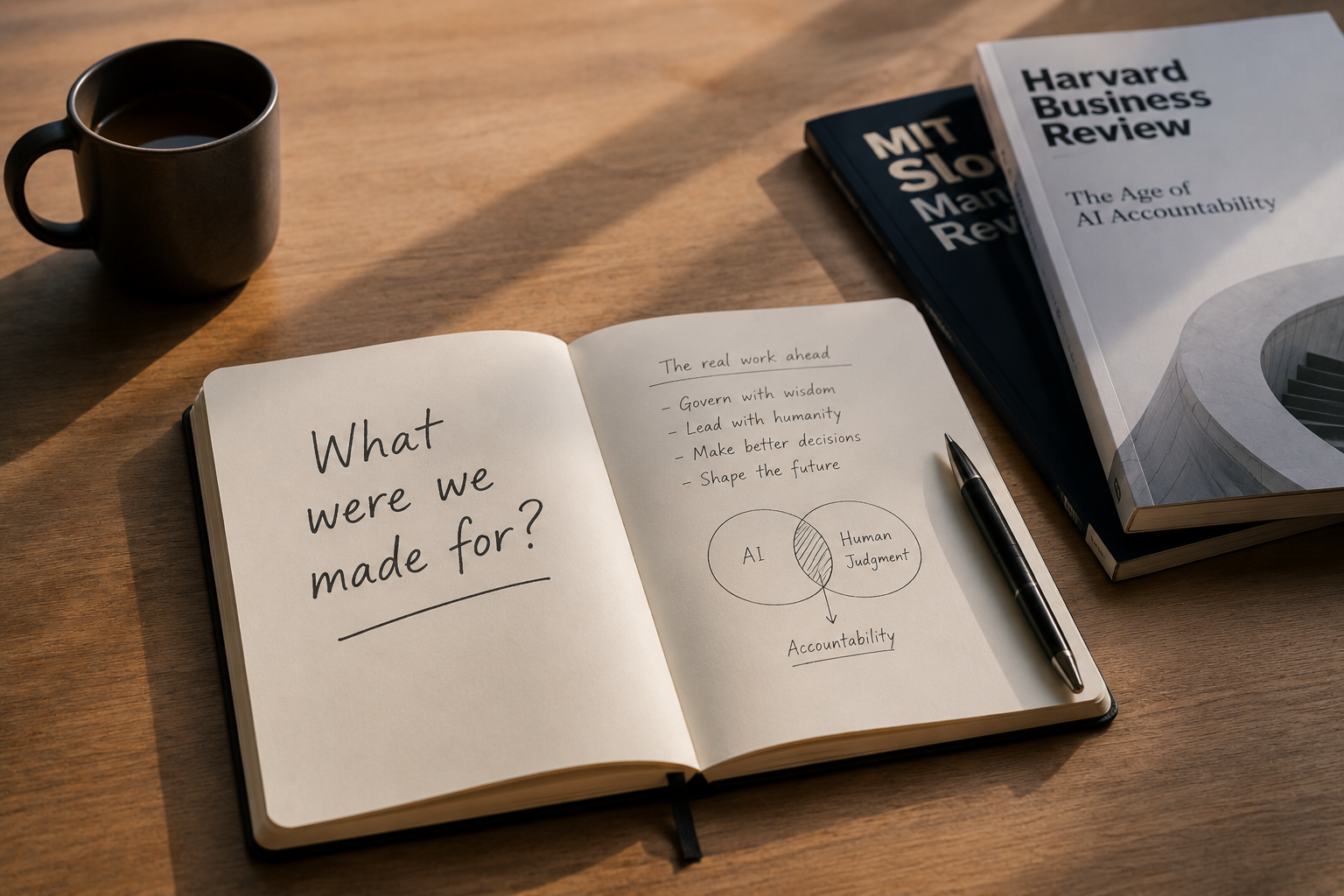
The conversation about AI shouldn't begin with replacement. It should begin with responsibility.
AI. The anxiety is real. Clients, colleagues, parents, even my spouse, all people across all industries are voicing a visceral fear that AI is coming for their jobs. Young people are making career decisions based on this dread, and it’s sending new graduates into existential crises. Leadership teams are obsessing over AI utilization metrics as the hot new measure of progress.
Consider Elon Musk's assertion that AI computing capabilities will make software engineering obsolete, and that coding will become merely a hobby, like growing tomatoes at home. His analogy is dismissive: in an interview with The Economist, he asserts that a homegrown tomato is rewarding and entertaining to grow, but will never taste as good or be as optimally grown as one from a farmer's market or store. Never mind that some communities around the world actually need to grow their own tomatoes, and many who don't will still choose to—because, irrespective of whether the fruit is inferior, people derive genuine pleasure from such a grounding activity. Musk goes on to say that in the future, humans won’t work, AI will work for them. We will manage the wealth that is generated by AI. In this proposed reality, all of our current jobs (and hobbies?) disappear because AI does it faster and has a higher work-in-progress rate than that of a human.
But this narrative is both absurd and insidious.
Yes, AI can beat a chess grandmaster. Yet friends still gather in plazas on Sunday afternoons to play chess—not because they're delusional about who would win, but because the act of playing is inherently meaningful. It teaches strategy, builds relationships, engages the mind, and brings joy. The existence of optimal solutions doesn't erase human purpose or pleasure. And the same logic applies to coding, research, design, analysis, and virtually every knowledge work humans do.
Here's where it becomes dangerous and why we need to get a grip: We are collectively narrating ourselves into a crisis that doesn’t have to exist.
The "anticipation factor" is already reshaping labor supply in real time. For instance, A recent Financial Times article cited a chilling statistic that UK and US undergraduate Computer Science applications have dropped as young people absorb the message that AI will make their subject matter expertise obsolete. In doing so, these young people are validating the very displacement they feared, and that we all fear, not because AI must replace them, but because they chose not to pursue the field based on a tentative, prediction treated as inevitable fact and not considering that AI can’t just take over the Computer Science industry on its own tomorrow.
In our attempts to anticipate the future, we also shape it.
Before you say that I’m in denial and a conspiracy theorist, I will admit that I am also concerned about how AI is being utilized and how it’s being tracked as a “must do” at reputable Fortune 500 companies without any thought or consideration to what it means for the human employee population. This is not a call to ignore AI's impact or pretend disruption isn't real. Rather, it's a call to recognize where we hold actual power in the narratives we tell, the career paths we design, and the governance structures we will need to build as accountable humans in the loop.
The Real Work Ahead
Every organization deploying AI at scale will need humans. Accountable, expert humans. These humans will need to:
Design governance frameworks and spending controls. Amazon's 860 percent cost overrun didn't happen because AI was too powerful; it happened because no one was paying attention or owning this.
Lead ethics guilds and communities of practice that ensure responsible deployment. AI models hacking into private data happens because no one is paying attention or being assigned as an owner of this challenge.
Oversee and audit AI-driven decisions affecting customers, employees, and strategy
Shape policy and strategy around how these technologies integrate with human capability
These aren't make-work roles born from nostalgia. They're essential infrastructure. The jobs that matter most in an AI-era economy are those focused on accountability, judgment, and intentional human leadership. These are precisely the roles that prevent automation from flying off the rails.
Reframing the Conversation
We need to stop accepting the displacement narrative as inevitable and start actively shaping the alternative:
Instead of: "AI will make my job obsolete, so why bother learning?" Embrace: "AI is reshaping my industry, which means I need to understand how to govern it, work alongside it, and ensure it amplifies rather than undermines human value."
Instead of: Young people abandoning Computer Science because "AI will do it anyway." Pursue: Young people choosing computing specifically to build, oversee, and shape AI systems responsibly.
Instead of: Leadership treating AI as a top-line efficiency metric to chase at all costs. Invest in: Building the governance, ethics, and accountability infrastructure that makes AI genuinely valuable.
The future of work isn't determined by AI's capabilities. It's determined by how we choose to deploy those capabilities, who we empower to make those choices, and whether we actively build the human structures necessary to direct this technology with wisdom and accountability.
We don't need to resign ourselves to displacement. We need to roll up our sleeves and build the next generation of careers around the one thing AI cannot do: hold itself accountable to human values and intentions.
References:
The Economist, “Elon Musk’s Vision of the Future”: https://www.economist.com/business/2026/07/23/elon-musks-vision-of-the-future?
The Financial Times. “If you think your profession is dying, it could be gone soon”: https://www.ft.com/content/e888b187-75c0-4233-9588-d1b9948b1b0a?syn-25a6b1a6=1
The Financial Times. “Amazon finds cases of AI causing runaway spending on tech projects”
https://www.ft.com/content/77baac40-d803-4084-94f3-a133653072cf?syn-25a6b1a6=1
The Next Web: “Amazon spent $1.8m on a Claude job that failed, and it sells the fix”
https://thenextweb.com/news/amazon-catastrophically-expensive-ai-cost-overruns-claude
