
Why Most Product Training Doesn't Change Behavior
By Mariana Abdala
Organizations pour real time and money into product training. Teams attend workshops, earn certifications, learn new frameworks. Shared vocabulary improves for a few weeks. Leaders feel momentum!
But you take a look around and suddenly realize that very little actually changes.
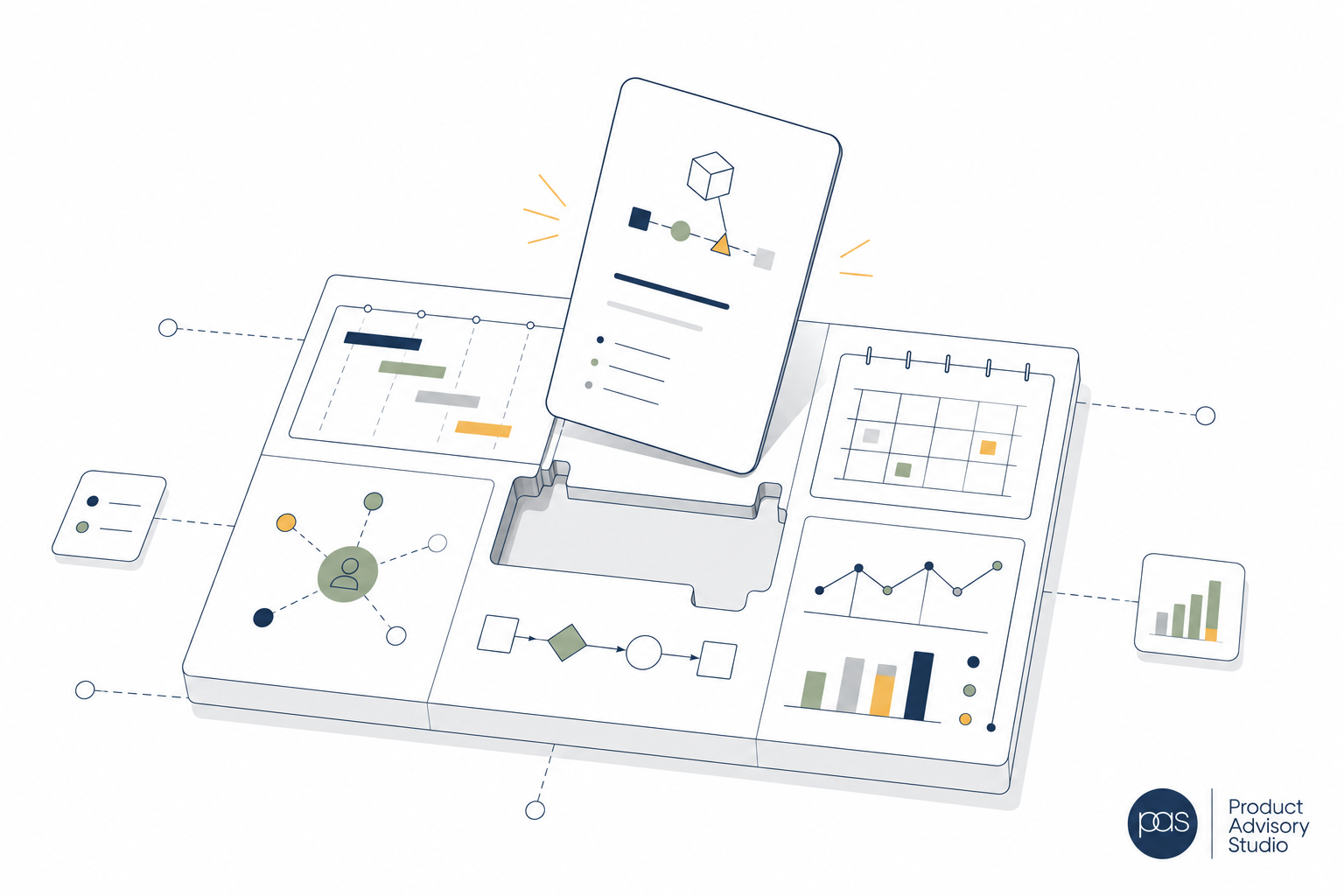
Learning introduces new concepts. Repeated practice in real work turns them into lasting behaviors.
Prioritization stays murky. Roadmaps drift from strategy. Product managers stay buried in coordination. Discovery happens in bursts, planning stays reactive, and the first time pressure hits, everyone reverts to old habits.
This happens more often than anyone wants to admit, and it's usually not because the training was bad. The problem is that most training is disconnected from the place where behavior actually forms: the day-to-day operating environment.
Learning something and doing it are not the same thing
A lot of training is built as a one-off event. Teams step out of their work, absorb concepts for a day or two, then go right back to an environment that still rewards the same behaviors, incentives, and planning rhythms as before. We expect transformation, but we leave the system around the work untouched.
Product work is contextual. How a team prioritizes, escalates, handles dependencies, reads customer insight, or defines value is shaped by the environment around it, and those behaviors get reinforced every single day. A two-day workshop can't outweigh that. It's why so many teams get a "training high," then watch the learning fade the moment delivery pressure returns.
Where the one-size-fits-all model breaks
Training usually fails for two reasons.
There's no application layer. Teams learn a prioritization framework but never use it on a live roadmap decision. They talk about customer-centricity without pressure-testing a real assumption tied to something they're shipping. The learning stays theoretical.
Leadership alignment gets treated as a side note. Teams watch what leaders reward in planning conversations, escalations, and reporting. If leaders keep emphasizing output and date certainty over outcomes and evidence, teams adapt to that, not to the framework they learned last month. What looks like a skills gap is often an alignment gap underneath.
We saw this with a global professional services firm. Their product leaders could talk fluently about outcomes, discovery, and prioritization, so on paper the capability was there. But once we spent time inside their planning conversations, the real picture showed up: every quarterly discussion still centered on delivery commitments and dates, so that's what teams optimized for. The gap wasn't knowledge. It was a planning rhythm that kept rewarding the old behavior. So we didn't run another course. We embedded the work into their existing quarterly planning and brought leaders into the same room, so what they rewarded started shifting alongside the teams.
Context is the work
This shows up most in complex enterprises, where teams navigate legacy operating models, heavy dependencies, regulatory constraints, and constant cross-functional coordination. People can understand modern product concepts perfectly well and still not be able to apply them inside how their organization actually runs. That's exactly why we don't walk in with a fixed curriculum.
A global pharmaceutical client showed us another version of this. Their teams understood discovery. What a standard program ignores is that they work inside strict regulatory and compliance constraints, where "go talk to more customers" creates risk, not capability. Because we took the time to learn how decisions actually move through their environment, we shaped the approach around it: lighter-weight evidence gathering that respected their compliance gates, and discovery practices designed for a regulated context. The concepts weren't new to them. Making them usable inside their world was the work.
That's the difference between informed, contextual capability building and a packaged curriculum applied the same way everywhere. The first one starts by getting to know the team, their constraints, and their environment before deciding what to teach or how.
What actually builds capability
The capability development that sticks doesn't happen off to the side. It happens inside the work, where teams apply concepts immediately to real decisions, tradeoffs, and execution.
That's the whole idea behind how we work. We don't just run a workshop and leave. We teach new ways of working methodically, by role and by team, in the actual flow of the work. We assess where the behavioral gaps are. We coach through the hard spots. And we work closely with leaders so the operating environment evolves alongside the people, not after them.
Behavior change isn't linear. Teams don't become more strategic because they sit through a session. Organizations mature through repeated exposure, application, reflection, adjustment, and leadership reinforcement, all embedded in real work. That's the line between organizations that collect training artifacts and organizations that actually change how decisions get made.
The environments where capability really takes hold tend to share a few things:
It’s clear how the learning topics connect to active work in people’s daily lives
Leaders reinforce the same behaviors being taught. They know they are models
Teams get to apply concepts immediately and they know leadership expects to see this behavior shift
Coaching continues past the workshop
Operating ceremonies are iteratively adjusted to support the new behaviors
Capability development is treated as an ongoing system with just-in-time support, instead of a one-time event
Capability gets built through repeated practice, inside the actual environments where product decisions get made.
If your last training program faded faster than the energy in the room, it's probably not your team. It's the system around the work. Curious what you're seeing in your organizations.
