
By Mariana Abdala
When I led platform technology at LendingClub (now Happen Bank), I watched this dynamic unfold in real time. Each quarter, our roadmap got bulkier. New dependencies materialized across compliance, fraud risk, and information security systems. Regulatory requirements landed in our backlog without needed context and suddenly our typical 6-week roadmap reviews had the added layer of OKR reporting, which never seemed to be measuring what we were actually producing. By mid-year, our engineering calendar looked like a Tetris game—planning sprints, delivery standups, architecture reviews, compliance gates, all stacking into each other.
The work never stopped. There was always another initiative, another escalation, another stakeholder asking for prioritization in a system where everything felt urgent.
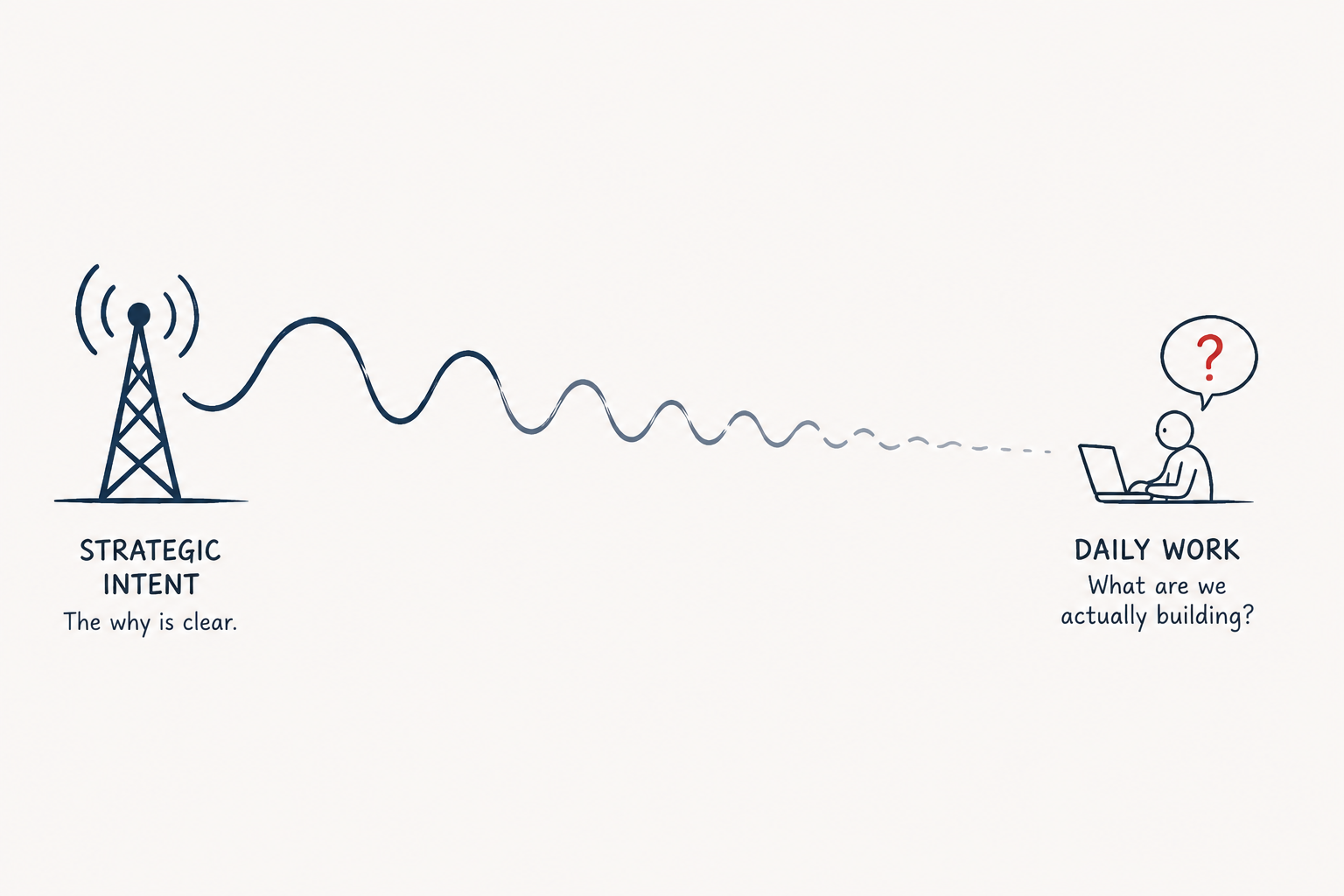
As strategy moves through layers of planning, prioritization, and delivery, the signal can weaken. The work still reaches the team, but the context behind it often doesn’t.
What I didn't notice until much later, until I started talking with other technical leaders at other FinTech firms, was that somewhere in that acceleration, my teams had lost something fundamental: they'd stopped understanding why we were building what we were building. They showed up, executed well, and hit their Agile development commitments. But the thread connecting their work to the actual business outcome had become thin. In a regulated industry where every decision ripples across systems and compliance frameworks, that disconnection starts to matter.
A strategic initiative begins with clear intent at the leadership level. Customer pressures, business goals, market dynamics, operational concerns, and investment priorities shape the direction. Typically, the next step is that quarterly objectives get defined at the team level. Objectives get translated into roadmap items, and the key results have to get defined as something measurable, usually with the help of KPIs. At a quarterly cadence, you have teams taking their roadmaps items and splitting them into initiatives, dependencies, milestones, and delivery tracks distributed across multiple teams. Work enters ticketing systems, planning rituals, handoff processes, governance layers, and execution workflows that stretch across functions and organizational boundaries. This is all good practice. However, with every step we start to lose a little of the context and the strategy.
At every stage, context thins out.
By the time work reaches delivery teams, people are executing fragments of strategy without understanding the broader rationale behind them. Priorities arrive disconnected from the tradeoffs that shaped them. Teams inherit roadmap commitments without visibility into customer problems, business constraints, or outcome expectations attached to the work.
Execution continues, but strategic clarity fades.
This is where enterprise product environments begin drifting into a dangerous pattern: high activity combined with low contextual understanding.
Why is this a problem?
This was the trap we fell into at LendingClub about six years ago. Our product managers spent their time bouncing between features for retail investors and borrowers without doing the ROI calculator on whether it was more helpful to focus on end customer product features or internal platform customers loan servicing and collections. There was an overall lack of coordinating across dependencies rather than shaping direction. Discovery became transactional: a checklist of regulatory requirements and technical constraints rather than a conversation about what actually mattered. Delivery meetings narrowed to: "Can we ship this by quarter-end?" instead of "How does this reduce reconciliation friction for our traders?"
Without that strategic framing, escalations multiplied. Teams couldn't resolve ambiguity independently and it felt like every small decision climbed the ladder.
The PM's job is to be the keeper of context. That's not a communication problem solved by a quarterly all-hands or a strategy deck. Context has to live inside how work moves: in how planning conversations explain tradeoffs, in roadmaps that communicate outcomes rather than feature lists, in discovery practices that surface customer impact, not just technical requirements.
The strongest product leaders I've worked with embedded context directly into their operating systems. They reinforced it across planning cycles and prioritization conversations. They explained why we were deprioritizing a faster settlement layer in favor of risk infrastructure—because understanding shaped better decisions downstream.
When teams understand the reasoning behind priorities and the customer dynamics driving them, they execute thoughtfully. Initiative quality improves because judgment improves. And people reconnect their work to actual outcomes.
Context erosion is rarely dramatic. It accumulates across handoffs and planning layers until the organization finds itself surrounded by activity while struggling to answer: What are we actually trying to accomplish?
Protecting context is the PM's most important infrastructure work.
